







Advance TAU DLS wing review
- by Carlo Borsattino

Advance TAU DLS First Impressions Review
The Advance TAU DLS is Advance's new high-end EN C two-liner, built using the company's Durable Light Structure (DLS) construction. As with other DLS products, the aim is to reduce weight and packing volume through clever material choices and construction techniques while maintaining the durability expected from a standard wing.
After a first flight in punchy conditions, the TAU DLS proved to be both surprising and impressive. Rather than feeling like a lighter OMEGA 5 ULS, it revealed a character much closer to a high-aspect-ratio SIGMA 12 DLS.
Construction and Build Quality
Straight out of the bag, the TAU DLS makes an impression. The supplied DLS concertina bag is compact and well thought out, while the wing itself displays the level of finish and attention to detail that Advance is known for.
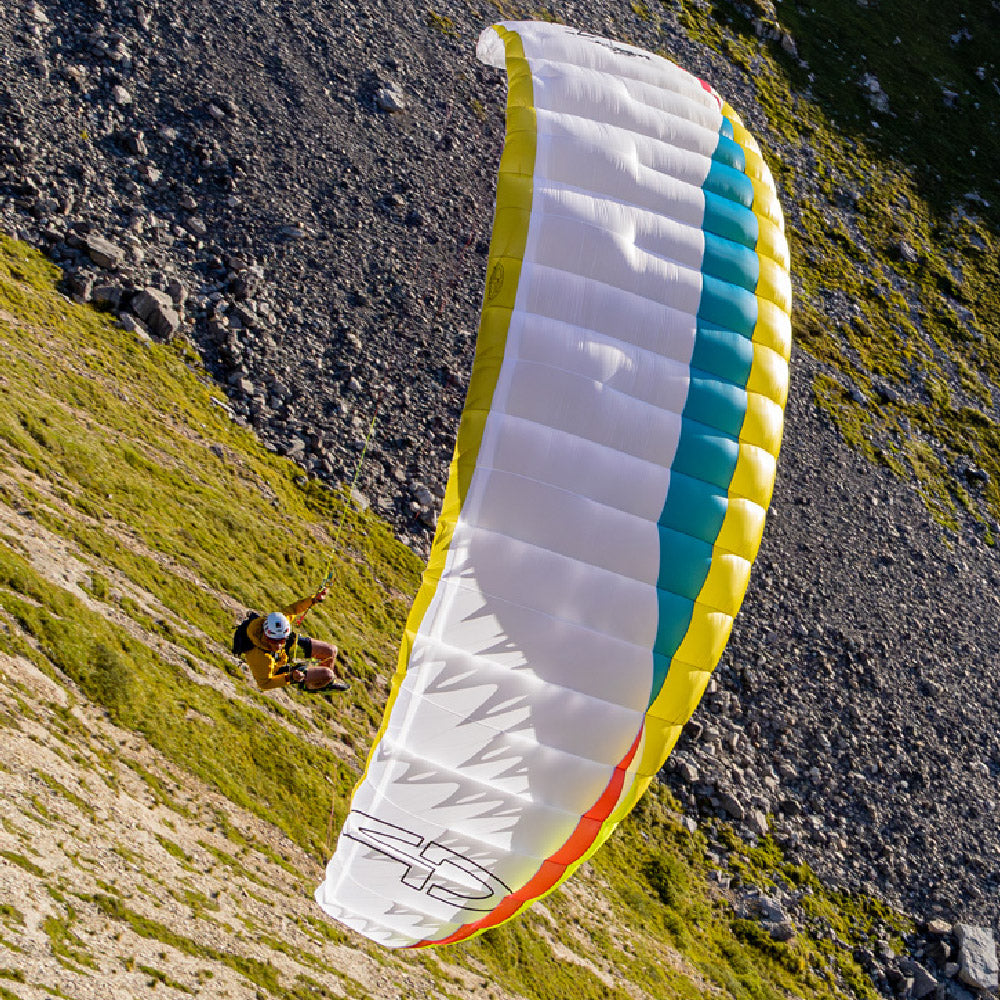
The leading edge features a moderate shark nose supported by Nitinol rods extending beyond the first line attachment points. Additional rods support the lower surface around the rear line area, while the trailing-edge reinforcements extend almost to the very back of the wing.
The risers are elegant and simple. Ronstan 20 mm pulleys are used throughout, the rear-riser handles are fixed carbon, and Advance's familiar magnetic brake handle system is retained. As expected in this class, the TAU DLS uses fully unsheathed lines.
Overall, the wing gives the impression of being purpose-built for competition and high-level XC flying.
Inflation and Ground Handling
The TAU DLS immediately communicates its character on the ground.
From the first inflation, the wing feels taut and cohesive. It rises cleanly and gives a strong sense of solidity. Compared with a SIGMA 12 DLS, however, there is a noticeable increase in pilot demand.
The tips require slightly more attention and management, reflecting the wing's higher aspect ratio and more performance-oriented nature.
It never feels excessive or intimidating, but it is clear that this is a proper high C rather than an especially forgiving mid-C.
In-Flight Character
The biggest surprise came once airborne.
Rather than feeling like a lower-aspect-ratio OMEGA 5 ULS, the TAU DLS feels much more like a higher-aspect-ratio SIGMA 12 DLS. The wing flies as a very unified structure, without the snakiness sometimes found in high-performance gliders.
While the tips naturally become slightly less cohesive near the stall point, the overall impression is one of tautness and stability across the entire span.
That reassuring solidity remained one of the defining characteristics throughout the flight.
Pilot Demands
Despite its confidence-inspiring feel, the TAU DLS is unquestionably a genuine high C.
The pilot demands are noticeably higher than those of the SIGMA 12 DLS, both in terms of the increased aspect ratio and the management required near the stall point.
The SIGMA is unusually forgiving for a C-class glider, whereas the TAU DLS requires greater precision and attention.
However, it never feels excessive. This is not a pseudo-C, nor is it a D wing disguised as a C. It simply occupies its place as a true high C.
Brake Feel and Handling
The brake pressure reflects the wing's character.
Brake inputs are firm and positive without being heavy, providing a direct and reassuring connection to the wing. Handling feels precise rather than playful, with plenty of authority throughout the brake range.
Pilots who appreciate clear feedback from the wing are likely to enjoy the TAU DLS's handling style.
Thermalling Performance
Thermalling performance was immediately impressive.
The TAU DLS felt efficient throughout every phase of flight, from launch and climb to glide and accelerated transitions. Even in punchy and unpleasant conditions, it remained easy to position accurately within thermals.
The wing climbs efficiently while maintaining its composed and solid feel.
Accelerated Flight and Rear-Riser Control
Accelerated flight was one of the highlights of the first impressions.
The TAU DLS builds speed quickly and feels genuinely fast, yet remains remarkably solid. The rear-riser system deserves particular praise.
Rear-riser pressures are light to moderate, making it easy to maintain an active connection with the wing while accelerated. Unlike some two-liners with heavy or stiff rear-riser systems, the TAU DLS encourages efficient flying on bar.
Flying through choppy air required very little intervention, but when active control was needed, the wing responded clearly and predictably.
Pilots looking to maximise efficiency while pushing into wind, crossing sink or optimising glide performance will likely appreciate how usable the accelerated control system feels.
Where Does the TAU DLS Fit?
Advance appear to have succeeded in creating a wing that delivers genuine top-end performance within the high-C category while remaining relatively accessible by the standards of the class.
The TAU DLS also fills an obvious gap within Advance's range. Previously, the progression from the IOTA 3 DLS through to the SIGMA and then the OMEGA involved a substantial jump.
The TAU DLS sits naturally between those wings, offering a logical next step for pilots progressing from a capable mid-C.
Comparisons
Compared with other wings in the class, the TAU DLS feels broadly comparable to gliders such as the Ozone Photon, PHI SCALA 2, ZOOM X2C and BGD Cure 3.
Its demands appear lower than those of the Gin GTO 3, which remains one of the more demanding wings in the category.
Perhaps most importantly, the TAU DLS does not feel like a "hot C". The pilot demands required simply to keep the wing overhead seem to sit somewhere around the middle of the category, perhaps even slightly below average for the class.
Who Is It For?
For SIGMA pilots looking to make the move into two-liner Cs, the TAU DLS represents a particularly logical progression.
Equally, pilots flying established mid-C gliders who genuinely feel ready to take the next step should place the TAU DLS firmly on their shortlist.
It rewards active, experienced pilots, but does so without demanding the constant intensity associated with the most aggressive wings in the class.
First Impressions Verdict
The Advance TAU DLS was not what was expected.
Rather than a lighter, lower-aspect-ratio OMEGA ULS, it feels like a higher-aspect-ratio, two-liner SIGMA DLS.
These are only first impressions, but they are very positive ones. The TAU DLS appears to combine the performance expected of a modern high C with a level of solidity and usability that could make it one of the standout wings in the category.
For pilots ready to step into the world of two-liner EN C gliders, the TAU DLS already looks like a very compelling option.
Flybubble video review
Brought to you by Flybubble
Like what we do? The best way to thank and support us is to buy gear from us and recommend us to others.
- Posted in:
- Articles
- Gear Guides
- News
- Paraglider Reviews


