




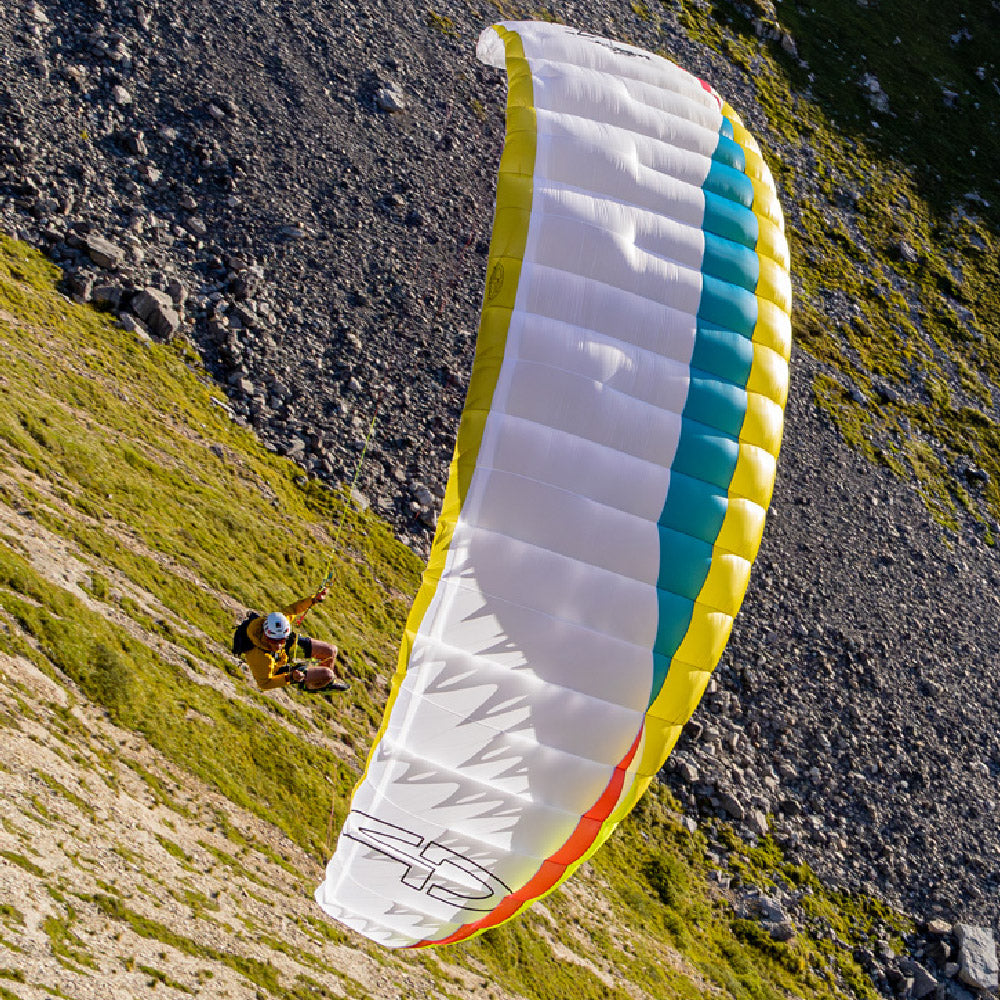




BGD CURE 3 paraglider test & review
- by Carlo Borsattino

We’ve just flown the BGD CURE 3 for the first time to get an early feel for where it sits in the high-C two-liner category. Conditions were ideal for testing, with dependable thermals and a mix of light and stronger winds—perfect for exploring its behaviour on the ground, in climbs, and on glide.
Ground Handling & Inflation
On the ground, the BGD CURE 3 immediately shows its slightly higher aspect ratio of 6.7. It’s not dramatically higher than other wings in the class, but enough to give it a more stretched, refined feel—comparable to the PHI SCALA 2. This brings a little extra tip management into play.
Ground handling feels appropriate for the category. It isn’t the easiest high-C on the market, mainly because of the higher aspect ratio and long rods, which require a touch more care when building a clean wall. Those who take a moment to lay it out properly will be rewarded with predictable behaviour.
Inflation includes a small, familiar pause - very reminiscent of the BGD DIVA 2 and BASE 3. This characteristic remains consistent across light and strong wind launches. The wing doesn’t rush up; instead it rises in a steady, controlled manner. This is typical of wings that prioritise structure and collapse resistance over minimal weight.
Overall, ground handling sits exactly where we’d expect for a performance-focused EN-C two-liner.
In the Air: Character & Design Lineage
Once airborne, the BGD CURE 3 quickly feels like part of the same family as the DIVA 2 and BASE 3. The similarities aren’t imagined—the design philosophy is shared: high camber, short lines, swept tips and a firm internal structure all contribute to a recognisable BGD feel.
The wing is very solid. BGD continues its approach of using extensive rod reinforcement, trading a little weight and pack volume for impressive structural stability and collapse resistance. This pays off in the air, where the wing remains cohesive and reassuring even in sporty, active conditions.
Handling, Brake Feel & Stall Point
Handling is one area where the BGD CURE 3 shines. Many EN-C and EN-D two-liners suffer from long brake travel and somewhat muted feeling. The CURE 3 does not. The brake travel is relatively short, the stall point is clear, and the wing offers surprisingly good feel and authority for a two-liner.
The handling is direct, responsive and agile. In tight, narrow or punchy cores, the wing turns cleanly with minimal lag. Alongside the Artik 7 P and the Zoom X2C, the BGD CURE 3 stands out as one of the better-handling EN-C two-liners currently available.
There is one handling note worth mentioning: past roughly 45–60° in slow flight, pulling too much brake can cause the wing to drop back a little. This is entirely normal for a high-C two-liner and should pose no issue for pilots in this class.
Climb Performance & Feedback
Climb performance is excellent. The BGD CURE 3 bites into thermals efficiently and stays in the core without fuss. In weaker lift it climbs very well; in stronger, more aggressive lift it remains composed, resisting the tendency to spit the pilot out.
The wing moves around a little—similar to the DIVA 2—but remains reassuringly solid. The feedback is clear but not excessive. Pilots who like a wing that communicates what’s happening in the air will appreciate this. It gives useful information, not noise.
Pilot demands are aligned with the high-C category. It doesn’t feel like a D-class wing in disguise; the level of input required feels sensible and appropriate. Those familiar with wings like the SCALA 2 will feel at home here.
Importantly, feedback should not be mistaken for reduced safety. Some wings hide information and feel “quiet”, but that doesn’t make them safer. The CURE 3 offers the right balance of communication and solidity.
Glide, Speed & Rear-Riser Control
Performance on bar is one of the BGD CURE 3’s strongest points. The rear-riser control is excellent: moderate pressure, solid connection to the leading edge, and predictable behaviour when flying actively.
At speed, the wing feels fast, efficient and well-mannered. It’s among the quicker wings in the high-C category and remains impressively cohesive on bar. For pilots who make proper use of rear-riser steering, the two-liner benefits are very noticeable here.
Descent Techniques
Big ears
The split-A system uses a single outer A line. Pressure is moderate for a two-liner and easy enough to control. The ears flap slightly and introduce a little roll—common with high-arc designs. When released, they tend to stay in and usually need a pump to reopen.
Tip-stalls
Tip-stalls work very well on the BGD CURE 3. The lines are thin, but pressure is manageable. They feel more stable than big ears and, as expected, they pop out instantly without any pumping required. Descent rates appear broadly similar between the two methods.
Conclusion
The BGD CURE 3 delivers a strong first impression as a high-performance EN-C two-liner with an appealing blend of:
- excellent climb performance
- solid, cohesive structure
- agile, responsive handling
- meaningful, useful feedback
- high comfort and efficiency on bar
- very good rear-riser authority
It feels every bit a modern BGD performance wing - refined, informative, reassuring and efficient. For pilots looking for a fast, capable and well-balanced high-C two-liner, the BGD CURE 3 is a very promising option.
A full Flybubble review will follow after more extensive testing, but as first impressions go, the BGD CURE 3 stands out as one of the stronger contenders in its class.
Flybubble video review
Like what we do? The best way to thank and support us is to buy gear from us and recommend us to others.
- Posted in:
- Articles
- Gear Guides
- News
- Paraglider Reviews


