





Advance Lightness 4 pod harness – Follow-up Review
- by Carlo Borsattino

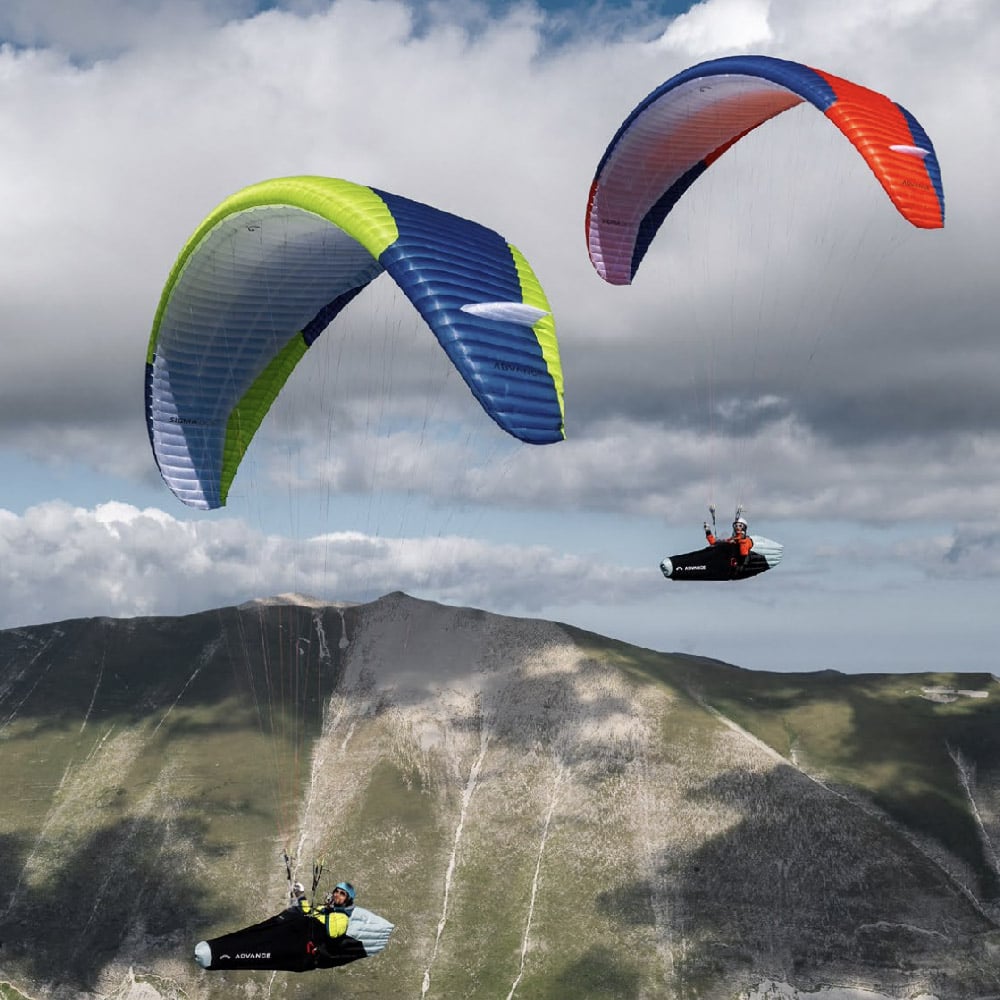
This is our follow-up review of the Advance Lightness 4. We published a first-look review several months ago, and since then both Nancy and Carlo have spent a lot of time flying this harness. This review focuses on what it is really like to live with and fly the Lightness 4 over longer flights and in a wide range of conditions.
Comfort and general feel
Comfort has continued to impress. The more hours flown in the Lightness 4, the more settled and natural it feels. Several flights of four to five hours, including multiple take-offs and landings, have only reinforced the initial impression: this is an exceptionally comfortable harness.
There are no noticeable pressure points, and the overall feeling is relaxed and supportive. Even in choppy or turbulent air, the harness remains comfortable and confidence-inspiring. The hammock-style design wraps around the hips and back, creating a supportive, cradled feeling that reduces fatigue over long flights.
Compared to the Lightness 3, the Lightness 4 places the pilot in a slightly more upright position, as already mentioned in our first-look review. This change is very noticeable and brings several benefits. Visibility ahead is improved, which makes a real difference during navigation and active flying. More laid-back, performance-oriented pod harnesses can reduce forward visibility, whereas the Lightness 4 strikes a more user-friendly balance.
Having recently flown highly performance-focused harnesses such as the Ozone Submarine, Gin Genie Race, Niviuk Drifter 2, and Supair Arrow, the difference is clear. Those harnesses place the pilot in a very laid-back position designed for pure performance. The Lightness 4 moves the centre of gravity slightly forward and encourages a more upright sitting position. For most pilots, this is both more comfortable and more accessible, especially for those considering their first pod harness.
Flying in smooth and light conditions
In smooth air and lighter lift, such as ridge soaring or gentle thermals, the Lightness 4 has a beautifully connected feeling. There is a clear sense of feedback through the harness, without it ever feeling nervous or twitchy.
The hammock-style design works particularly well here. It wraps around the pilot’s body, supporting the hips and back, which contributes directly to the high comfort level. For pilots who may have heard that hammock-style harnesses are unstable or unsuitable as a first pod, the Lightness 4 is well worth reconsidering. Its geometry and balance make it far more accessible than older designs.
When thermalling, the connection to the air is excellent. Subtle pushes and surges from the thermal are easy to feel, allowing small, precise adjustments in the turn. This is often described as a quality associated with seatboard harnesses, but in practice, it is more about harness geometry than the simple presence or absence of a seatboard. Thermalling in a weak, hard-to-centre lift is particularly enjoyable, as the harness provides clear, readable feedback without feeling demanding.
Stronger and more turbulent conditions
In stronger or more turbulent air, differences between harness types become more apparent. More structured, seatboard-equipped harnesses such as the Niviuk Arrow or Supair Delight 4 feel more locked-in and stable. In very punchy thermals, they offer greater leverage, but they also require more assertive input to maintain a tight turn.
With the Lightness 4 and hammock-style harnesses in general, the pilot will feel more of the movement. The harness allows a little more roll and feedback, which some pilots will notice immediately. That said, the Lightness 4 remains remarkably smooth and comfortable for its class.
An important point here applies to all pod harnesses, but especially to hammock designs. In turbulent air, the natural reaction is often to tense up and extend the arms and legs — the classic “starfish” reaction. In a pod harness, extending the legs increases the likelihood of unwanted rolling. The better response is to sit slightly more upright, bend the knees, and keep the centre of gravity compact.
This is easy to do in the Lightness 4. Even without a seatboard, the harness allows the pilot to sit up and fly actively. Regularly practising upright flight in any pod harness is strongly recommended, as it improves stability and control, particularly close to the ground.
Size and fit
At just over 181 cm in height and around 80 kg, the Medium size fits perfectly. Historically, Medium has consistently been the correct size in Advance harnesses, whereas some other brands can place pilots between sizes. The Lightness 4 continues this trend with a very predictable and comfortable fit.
Cockpit and speed system
The redesigned cockpit is a highlight of the Lightness 4. It opens easily from the front and allows simple access in flight, similar to the system used on the Niviuk Arrow. This design direction makes a lot of sense and works very well in practice.
During particularly energetic launches, the cockpit can occasionally pop open if the popper is not secured, but this is more a result of enthusiastic movement than a design flaw. Overall, the cockpit is practical, intuitive, and well executed.
The speed system is lightweight and effective, using lines and webbing rather than rigid bars. Once correctly adjusted, it is extremely comfortable to use. Pressure on the system is very light, comparable to much heavier competition harnesses.
Importantly, there is very little sensation of pressure pushing into the back when using speed, something that can be noticeable in some ultralight harnesses. The Lightness 4 feels more like a heavier, more substantial harness in this respect. There is no tendency for the harness to pitch the pilot up or down when applying speed, and stability remains excellent.
Handling and playful flying
When it comes to more dynamic flying — wingovers and playful manoeuvres — the Lightness 4 is genuinely fun. It is not an acro harness, but it strikes an excellent balance. Some harnesses are so stable that they inhibit weight shift, while others are overly unstable and feel vague.
Thanks to its geometry and slightly more upright seating position, the Lightness 4 offers precise and enjoyable control. For a hammock-style harness, it performs exceptionally well when playing with energy and weight shift.
Storage
Storage capacity has increased noticeably compared to the Lightness 3. While not enormous, it is generous for a lightweight pod harness. The rear storage, combined with additional space in the nose, makes it easy to carry essentials and extra layers. For pilots upgrading from the Lightness 2 or 3, the improvement in storage will be very welcome.
Take-off, landing, and getting into the pod
One particularly welcome addition is the optional foot bungee. Mounted on the left side and attached to the shoelace, it helps guide the foot back into the pod as soon as the heel is in place. This makes getting back into the harness significantly easier, especially after take-off.
With the Lightness 4 correctly adjusted, it is possible to get into the pod simply by pushing against the footplate and giving a small wriggle, without taking your hands off the controls. This allows the pilot to stay focused on flying the wing during the critical low-altitude phase.
The speedbag design also works very well for slope landings, top landings, and touch-and-goes. Getting the legs out of the pod is quick and intuitive.
This highlights why pod harnesses are usually recommended as a second or third harness. Early in a pilot’s progression, the performance benefits are minimal compared to the added complexity. The Lightness 4 does an excellent job of minimising that complexity, but the general principle still applies.
Protection system
The Lightness 4 is supplied with a foam protector only; Advance does not offer an inflatable option. Opinions on this will vary, but the foam protector works extremely well.
Beyond impact protection, the protector contributes to the structural integrity and handling of the harness. Changing between foam and airbag protectors on some harnesses can noticeably affect roll authority and overall feel. In the Lightness 4, the foam protector feels like an integral part of the design, and the result is a cohesive, well-balanced harness.
Comparison with other harnesses
In terms of weight shift, the Lightness 4 sits firmly in the middle ground. It is neither extremely weight-shifty nor overly stable, but very well balanced.
Comfort is right at the top of the category. One of the few harnesses that matches it in comfort is the Niviuk Arrow, which is heavier, bulkier, and uses a full seatboard.
For reference:
-
More weight-shifty harnesses include the Woody Valley GTO Light (1 and 2) and the Gin Genie X-Lite.
-
More stable harnesses include the Supair Delight series.
-
Harnesses such as the AirDesign Sock sit at a similar weight-shift level, but with a noticeably different feel.
In terms of build quality, Advance remains at the very top of the market, with Niviuk close behind and continually improving.
Windscreen
One small point of criticism concerns the windscreen. Compared to the Lightness 3, the Lightness 4 has a more upright seating position and a larger windscreen. As a result, the screen can feel quite close to the face for some pilots.
Some will appreciate the increased coverage, while others may find it slightly too tall. This is a personal preference, but it is worth noting when considering the harness.
Summary
The Advance Lightness 4 is an outstanding lightweight pod harness. It is supremely comfortable, beautifully made, and a pleasure to fly. Its balanced handling makes it an excellent all-rounder rather than an extreme, specialist design.
It is a very strong option for pilots considering their first pod harness and an easy recommendation for those upgrading from the Lightness 2, Lightness 3, Impress 3, or similar hammock-style harnesses. Pilots who enjoy this style of harness are very likely to love the Lightness 4.
Feedback from customers has been overwhelmingly positive, with many describing it as the most comfortable harness they have ever flown.
The harness is supplied with a high-quality backpack, which on its own would retail for well over €200. The backpack size is well matched to the harness, and even with filming equipment and a compact wing, there is ample space.
If you’re unsure whether the Lightness 4 is the right harness—or need help choosing from all the options—Flybubble MATCH Service can guide you to the perfect fit./p>
Flybubble video review
Like what we do? The best way to thank and support us is to buy gear from us and recommend us to others.
- Posted in:
- Articles
- Gear Guides
- Harness Reviews
- News


