





Advance PI 4 ULS – First Look review: The Evolution of the PI Series
- by Carlo Borsattino

Before we dive into the brand new PI 4 ULS, we have to talk about its popular predecessor: the PI 3
PI 3: The ULARP Benchmark
The PI series has been the most successful and versatile lightweight glider on the market for well over a decade, since the original PI launched in 2012. It's loved by many for its wonderful blend of minimal weight, maximum fun, and impressive performance. When the PI 3 was released in 2020 it was the culmination of that progressive evolution. For more than five years, the PI 3 has been the definitive benchmark in its class—the Ultralight Low Aspect Ratio Paraglider (ULARP[1]). For many it's not just a glider; it’s a modern classic that has defined the Hike & Fly category for countless pilots.
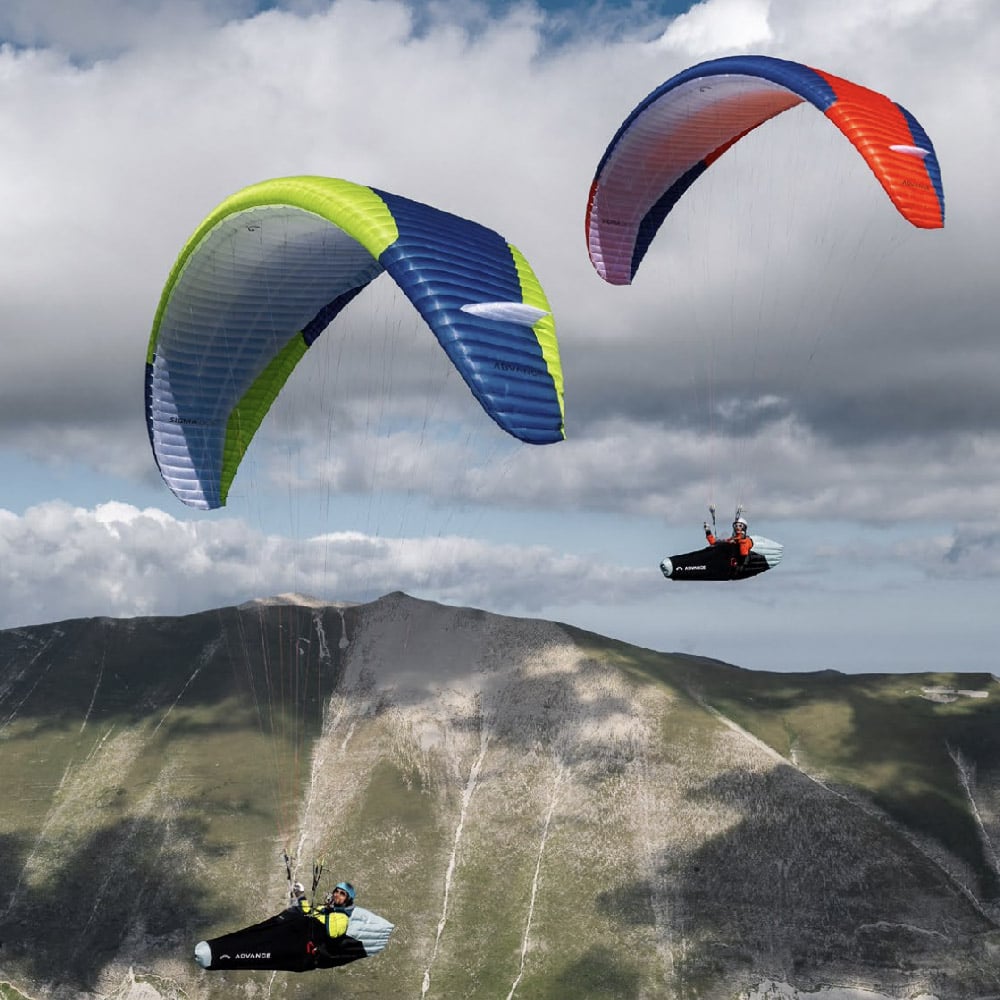
The PI 3 is, quite simply, the most successful, best-selling, and most-loved ULARP of its type by far—and all three models in the PI series have held that title. This success is why it is the definitive industry benchmark against which most, if not all, other manufacturers measure their own designs (like the AirDesign SuSi 4, Gin Yeti 6, and Ozone Ultralite 5). This enduring popularity stems from its three-in-one design: a Thermal wing, a Hike & Fly glider, and a Mini Wing all wrapped up in one highly accessible package.
Despite its high-end pedigree, being the top choice for many top athletes and adventurers, the pilot demands are very low, both on the ground and in the air, thanks to its exceptional passive safety and high in-flight comfort even in active conditions. This potent combination of low weight, small pack volume, and excellent performance is what made the PI 3 accessible and loved by nearly all pilots, from beginners to experts undertaking ambitious adventures worldwide, from the Alps to Patagonia.
Construction and Materials Philosophy
The PI 3 offers an exceptional package of ultra-low weight and ultra-small pack size—making it one of the lightest and most compact double-surface wings available. This is achieved without compromising on Advance’s signature build quality, beautiful looks, and finish.
For the PI 3, although built to the highest standards, using the most premium materials, all six sizes are optimised for lightness over robustness, requiring respect and careful handling. The material choice varies by size:
-
Small Sizes (16 and 19): Absolutely optimised for weight for big mountain adventures. These use Dominico 10D fabric on the top, bottom, and leading edge, and feature super-elastic Nitinol wires for the leading edge supports.
-
Large Sizes (21, 23, 25, 27): Still ultra-light, but offer a greater balance of weight, durability, and cost by using Porcher Skytex 27 and 32 fabrics with standard Nylon wires.
Across the entire range, the PI 3 introduced the world to the fantastic Edelrid Pro Dry lines, known for their exceptional water repellence and stability. It's clear a lot of thought went into every detail and finishing touch.
Ground Handling and Flight
The PI 3 is a very forgiving, well-balanced wing that is a lot of fun. Its flight characteristics are tailored across three weight ranges (Thermal, Hike & Fly, and Mini Wing). As Advance explains: "Higher wing loadings mean more demanding flight characteristics and handling. Small wings are basically more agile and demanding to fly, even when they are flown at normal wing loadings." This means pilot experience and demands increase significantly with wing loading and smaller sizes (e.g., flying the size 16 at 90 kg is far more dynamic—and demanding—than the size 27 in its thermic range).
The different weight ranges offer distinct flight behaviors:
-
Thermal Range (Lower Loading): The wing has a better sink rate and slightly lower air speed, making it well-suited for efficient thermalling and soaring in lighter winds.
-
Hike & Fly Range (Mid-Loading): This middle weight range is ideal for Hike & Fly, providing more loading for launching in a wider range of winds, with a slightly higher sink rate and air speed—the best all-round compromise.
-
Mini Wing Range (Upper Loading): The upper weight range gives higher airspeeds and sink rate, resulting in more dynamic behaviour best suited for higher wind soaring and faster descent flights.
Launch & Ground Handling: Overall, the ground handling and launch are super-easy and forgiving, making it a joy to handle. The pilot demands are very low, but of course, its behaviour changes according to the wind conditions.
-
Nil Wind Launches: Launching is super-easy in nil wind, and even manageable in light tailwinds (as often seen on alpine launches), though the light material requires care so it isn't blown down the hill. Advance thought of this by including Holding Pin Loops on the wing, allowing pilots to temporarily secure the glider with golf tees or similar pins in steep or slippery terrain (like snow).
-
Light Wind Launches: The wing inflates in the lightest zephyr, rises progressively and straight without any pause. Crucially, it slows and often stops autonomously at around 80 degrees, making it very forgiving of imperfect pitch control.
-
Strong Wind Launches: A well-known reality of all ultra-light wings (ULARPs) is that ground handling and launching in breezy conditions is more challenging—you can't have it all! This is simply because the lighter fabric gets lifted more easily, and the larger cell openings (emphasizing high safety) "catch the breeze" to cause the wing to "self-inflate." This requires better management and technique to actively hold them down (we recommend using the rear risers and brake lines, as shown in our video: https://www.youtube.com/watch?v=MdDofRxmPI0 ). The PI 3 is no exception, but the very forgiving inflation behaviour and user-friendly risers and line setup (with stabilo lines going to the Bs, not the Cs) help immensely. In a strong wind launch, the wing will tend to come up faster, requiring very little, if any, A-riser input. To launch, it’s often enough just to stop actively holding the wing down (releasing the rear risers, brakes towards the wing). Although the wing often stops before overflying, it’s a good idea to give a quick dab of brakes just before the top to slow it down. It responds well and easily to this, and is very forgiving of imperfect pilot input.
In-Flight Feel: The wing offers a very reassuring feeling yet provides good, clear feedback to the pilot. It features high collapse resistance without feeling 'planky' or 'stiff'.
Mini Wing Behaviour: Flown in the mini wing range, the wings feel speedy and dynamic but stop short of feeling extreme. The brake range remains good and forgiving. The wing converts energy well, giving it a nippy, sportscar-like feeling—great for turns, dolphining, and useful for fast nil-wind landings.
Pilot Suitability and Range of Use
Its high ease-of-use, high passive safety, and surprisingly good all-size performance make the PI 3 a fantastic option for almost everyone, often serving as the one and only wing for many pilots, or a beloved second wing for others. Some love it so much they have two or even three sizes, to suit different uses: light wind soaring and thermalling, Hike & Fly, high wind laminar soaring or para-alpinism (Climb & Fly).
Summary
In a nutshell, the PI 3 is beautifully made from the highest quality materials with meticulous quality control, resulting in a very good-looking wing with a truly elegant design. It is very forgiving on the ground and super-easy to launch, making it an absolute joy to kite and fly. It combines very high passive safety with surprisingly nice, playful handling and excellent performance across the board.
We have flown, tested, and loved this wing in all its six sizes extensively. From our ongoing testing and comparing of many ULARP wings, we felt that, although some excellent new models from other brands have caught up and were getting very close, the PI 3 still offered one of the best all-round packages in its class—a truly excellent all-round compromise of performance, safety, handling, and weight—right up until its successor was announced. Advance clearly felt that to reclaim the top spot in the ULARP category, they needed to bring out the PI 4, making significant improvements on what was already one of the very best available.
The Successor: PI 4 ULS (PI ULS)
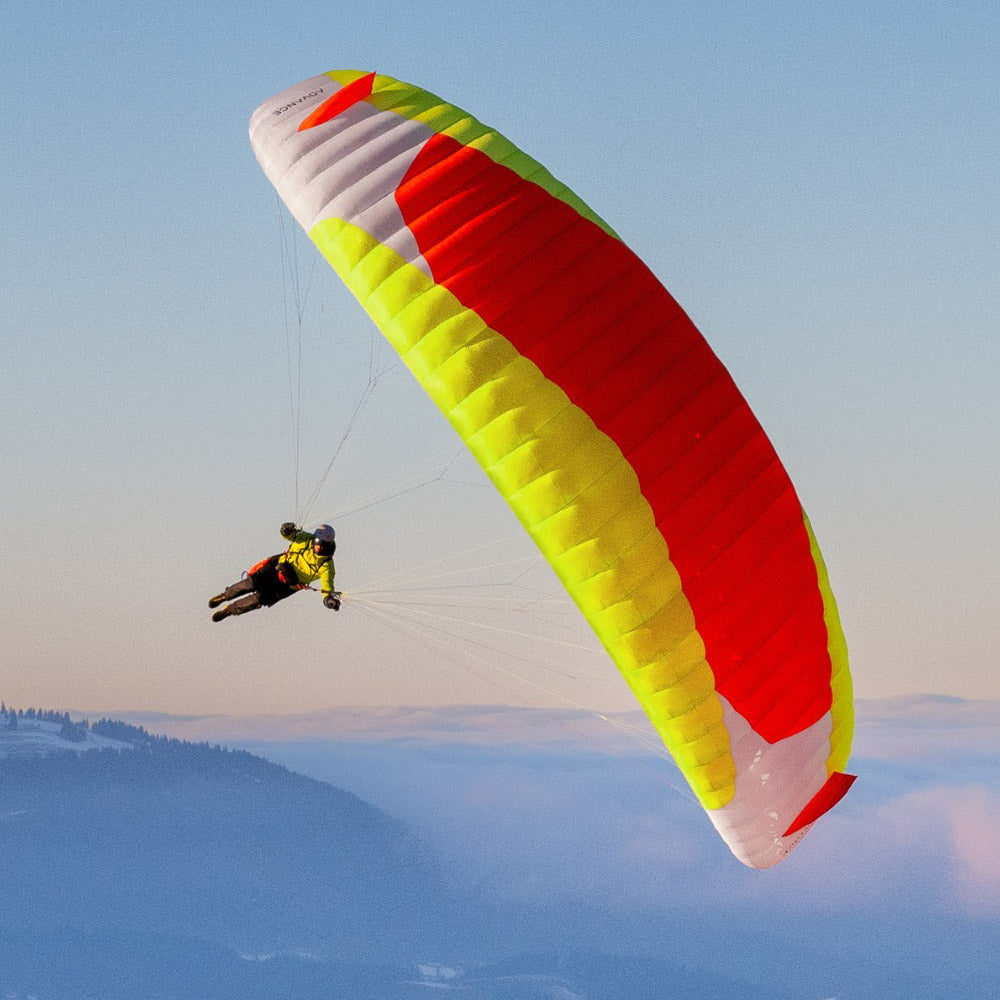
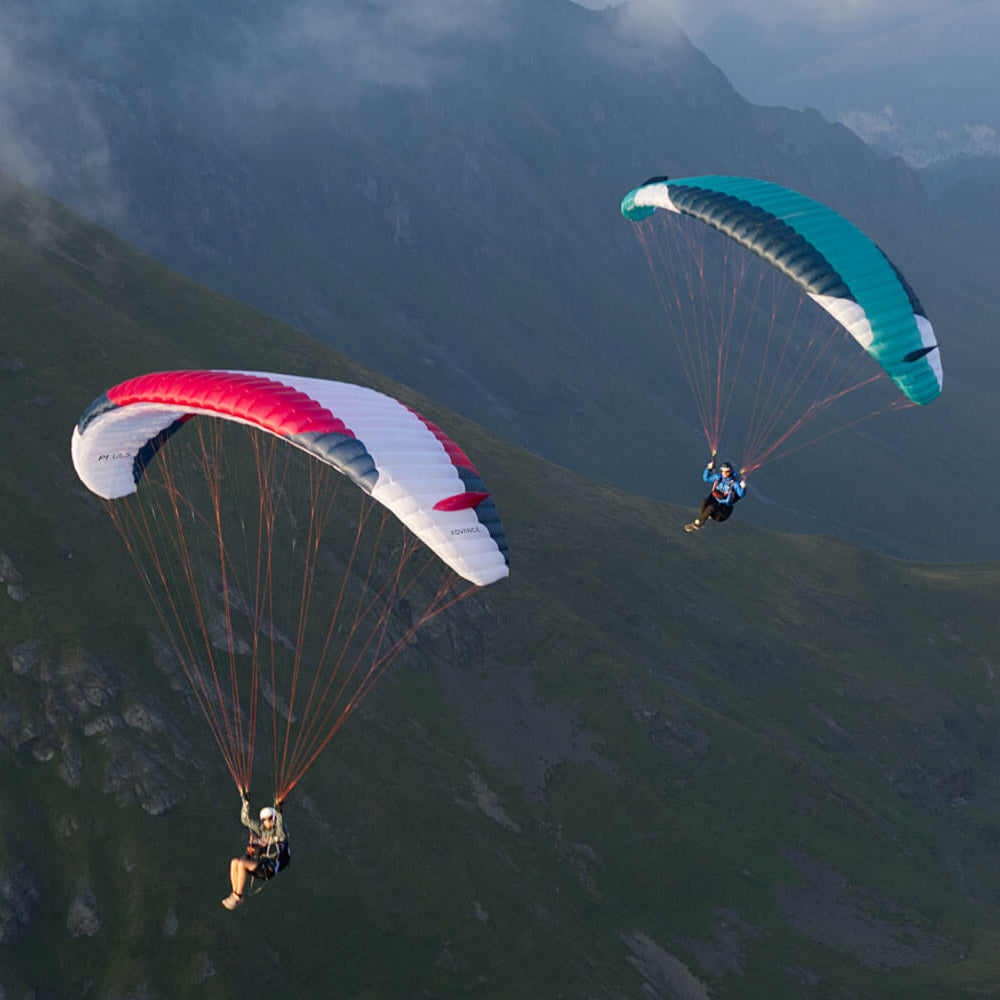
The PI 3 set the bar exceptionally high. Its successor is officially named the PI ULS, but to make it absolutely clear that it replaces the PI 3, we are referring to it as the PI 4 ULS (or simply the PI 4).
The PI 4 ULS embodies Advance’s Ultra Lightweight Structure (ULS) philosophy, focusing on uncompromising lightness and maximum compactness for extreme and specialised applications. The new size 14 starts at just 1.65 kg, underlining just how far Advance has pushed weight reduction. This is also where the distinction between ULS and Advance’s DLS (Durable Lightweight Structure) naming becomes important: ULS prioritises absolute lightness and packability, whereas DLS balances significant weight reduction with everyday robustness.
One of the most significant changes compared to the PI 3 is the refined size range. The PI 4 now comes in seven sizes, with continuous 2 m² increments (14, 16, 18, 20, 22, 24, 26), closing the gap that previously existed between the 16 and 19. Reflecting the wider trend towards smaller, more highly loaded wings, the surface areas of the larger sizes have been reduced—for example, the PI 4 size 26 replaces the PI 3 size 27—while maintaining the same pilot requirements and certification. From size 20 upwards, a new material mix further reduces both weight and pack volume, and the size 14 comes with ultralight risers as standard, optional on sizes 16 and 18.
Given how highly regarded the PI 3 remains, the PI 4 ULS inevitably invites direct comparison. In our opinion, first impressions are very much about evolution rather than reinvention. A PI 3 pilot will immediately feel at home, but with almost every detail refined—and some noticeably improved.
Build Quality & Details
Starting with the risers, the build quality is superb. The details are beautifully executed, very clean, and precisely finished. The A-risers feature a split A, and as expected on an ultralight wing, the PI 4 uses Dyneema soft links. The brake setup includes a small mini popper, a stainless steel brake swivel to reduce line twists, and a small ceramic ring—lightweight, functional, and neatly integrated.
Looking at the lines, even the stitching stands out as exceptionally clean. All lines are fully unsheathed, as expected on an ultralight wing, but they are coated and colour-coded, making identification straightforward. At the very bottom, small protective sleeves help guard against abrasion, after which the lines continue upwards unsheathed. The stabilo lines have only a very short sheathed section, while the lower part of the main brake line is sheathed. Overall, the execution feels thoughtful and purpose-driven rather than minimal for the sake of it.
Ground Handling & Inflation
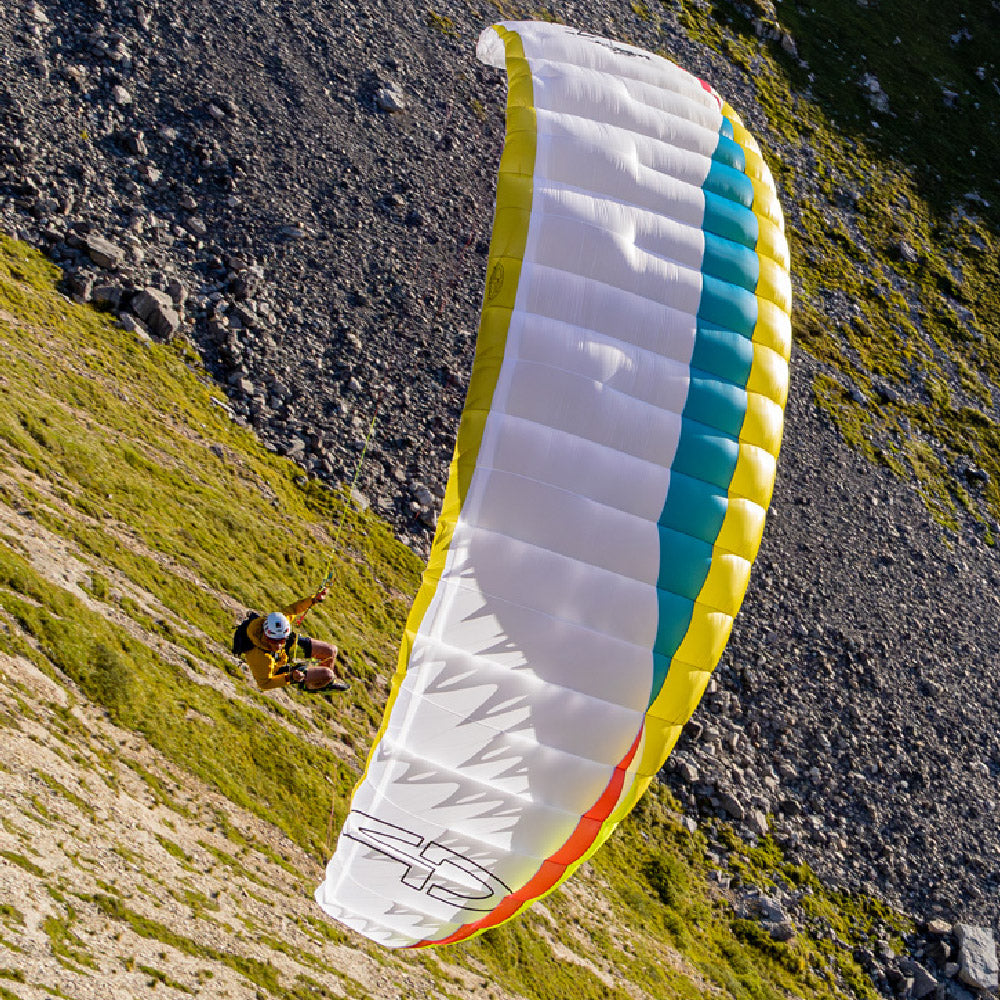
On the ground, the PI 4 ULS impresses immediately. Inflation is very progressive, rising smoothly from the ground all the way to the top. In even a light breeze, very little input is needed—the wing simply comes up cleanly and predictably. Despite the relatively low aspect ratio, large cell openings, and light fabric, ground handling remains extremely manageable and confidence-inspiring.
As with this type of wing, flying on the rear risers feels natural and effective, and the PI 4 responds beautifully to this style of control. It almost feels like you can just let it fly.
Handling & Feel in the Air
In terms of brake feel and overall handling, the PI 4 ULS shares some family resemblance with wings like the Theta and the Epsilon. There’s a similar sense of precision, but with a slightly calmer, more forgiving character. That said, responsiveness is still very much there. The wing feels playful and communicative, making it easy to feel exactly where it is in the air and how it’s moving.
As conditions become gustier, the PI 4 remains forgiving if the pilot is a little rough or imprecise on the brakes. At the same time, when precision is demanded, it delivers. There is a slight delay in inputs—typical of a higher, sportier wing—but it never feels dull or disconnected. Instead, it strikes a well-judged balance between calmness and engagement, remaining playful without becoming overreactive.
First Flight Impressions
These impressions are based on flying the size 20, close to the top of the extended weight range at around 88–90 kg all-up with a lighter kit. Even at this loading, the PI 4 ULS is super easy to launch, very comfortable in the air, and genuinely enjoyable to fly. Turns are sharp and precise, yet always calm and predictable.
Inflation remains easy and controllable, and ground handling never feels compromised despite the high safety and lightweight construction. Performance feels very strong—arguably even better than the PI 3 based on initial impressions—but this is something we look forward to validating with more extensive testing.
Early Verdict
In our opinion, the PI 4 ULS is a clear and convincing evolution of the PI 3. It retains everything that made the previous generation so popular—versatility, safety, and fun—while refining the details, improving packability, and subtly raising performance. We’ve tested every generation and size of the PI series so far, and we’re very much looking forward to spending more time with the PI 4 ULS over the coming months and years to fully explore its potential.
The PI Series Evolution
The PI series has continually broadened its size range to accommodate more pilots and uses.
-
PI (June 2012): 2 sizes (19, 23); 50–115 kg certified all-up weight range. More info: https://flybubble.com/advance-pi
-
PI 2 (Nov 2015): 4 sizes (16, 19, 23, 27); 50–120 kg range. More info: https://flybubble.com/advance-pi-2
-
PI 3 (Aug 2020): 6 sizes (16, 19, 21, 23, 25, 27); 50–120 kg range. More info: https://flybubble.com/advance-pi-3
-
PI 4 ULS (Sept 2025): 7 sizes (14, 16, 18, 20, 22, 24, 26); 50–119 kg range. More info: https://flybubble.com/advance-pi-4-uls
PI (Original)
When the original PI launched, it offered the best all-round package in its class and was quite revolutionary. "Forget Hike-and-Fly, this is Fly-and-Hike!" enthused Marcus King in his glowing review for XC Mag. The PI came in two sizes, 19 and 23, covering certified take-off weights of 50–115 kg, and a range of use from "Hike & Fly Pleasure" (lower loaded) to "Mountain Intense" (higher loaded).
The PI had a flat aspect ratio of 4.5, 35 cells, and a simple 2-riser setup (A and B). It was flight-certified EN B or C, depending on wing size and loading, without a speed system as standard. Optional speed risers (with speed system and trimmers) could be fitted, adding 12 km/h with the speed bar or 8 km/h with the trimmers, but this invalidated the EN flight certification.
-
Size 19: AUW 50-95 kg; EN/LTF C; weight 2.45 kg.
-
Size 23: AUW 65-115 kg (65-99 kg EN/LTF B; 100-115 kg EN/LTF C); weight 2.85 kg.
-
Video Fun: See Carlo having fun with the original PI and EASINESS harness: https://www.youtube.com/watch?v=0ciaKvM5cNk
PI 2
Released in 2015, the PI 2 eclipsed its predecessor, offering a marked improvement on an already very successful wing. It established the series' versatility by offering four sizes (16, 19, 23, and 27) and introducing three distinct weight ranges (Thermal, Hike & Fly, Mini Wing) covering 50–120 kg.
Technically, the PI 2 maintained the flat aspect ratio of 4.5 but increased the cell count to 39 and utilized 3 risers. Crucially, the PI 2 was certified with a speed system (no trimmers).
-
Size 16: 50-90 kg (EN/LTF C); weight 2.21 kg.
-
Size 19: 50-75 kg (EN/LTF B); 75-95 kg (EN/LTF C); weight 2.51 kg.
-
Size 23: 65-95 kg (EN/LTF A); 95-110 kg (EN/LTF B); weight 2.88 kg.
-
Size 27: 75-105 kg (EN/LTF A); 105-120 kg (EN/LTF B); weight 3.26 kg.
-
Read More & Watch: See our PI 2 written review and video: https://flybubble.com/blog/advance-pi-2-reviews and https://www.youtube.com/watch?v=VwQ8lkZ2azg
Flybubble note:
[1] ULARP stands for Ultralight Low Aspect Ratio Paraglider (pronounced "OO-larp"). We created this unique acronym to simplify discussion of this increasingly popular class of wing, and we're happy to launch the term with this review!
- Posted in:
- Articles
- Gear Guides
- News
- Paraglider Reviews


